
When you search for B.A.U.D. Trauma Reset Therapy vs. talk therapy, you get pages of conflicting opinions. But do you know how trauma coaching can help? Some sources claim talk therapy is the only proven route.
Others insist nervous-system-based methods work faster. If you are not sure who to trust or what actually fits your situation, this article gives you a clear framework.
Both paths can support healing. The right one depends on your history, your goals, and whether you need licensed clinical treatment or coaching-based support. This article breaks down the real differences so you can make a confident decision.
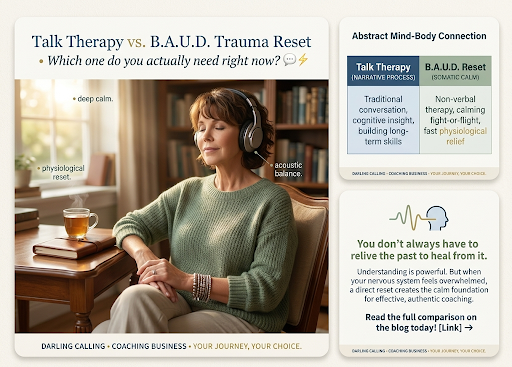
Talk therapy suits people with diagnosed PTSD who require licensed clinical treatment, while B.A.U.D. Trauma Reset Therapy fits women 45+ and individuals navigating divorce, relationship stress, or life transitions who want nervous-system relief without reliving the event.
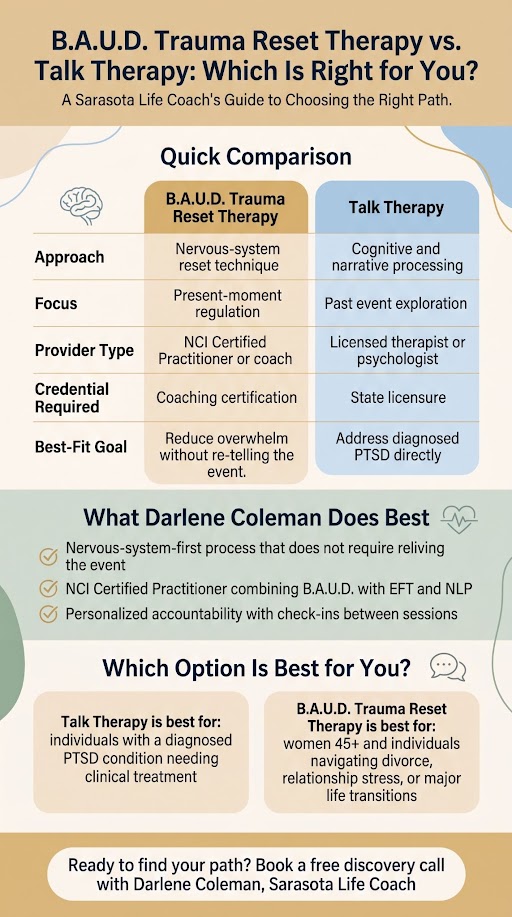
Quick Comparison: B.A.U.D. Trauma Reset Therapy vs. Talk Therapy
B.A.U.D. Trauma Reset Therapy focuses on the nervous system without requiring detailed trauma recounting, while talk therapy processes the trauma narrative through licensed clinical methods.
| Criterion | B.A.U.D. Trauma Reset Therapy | Talk Therapy |
| Approach | Nervous-system reset technique | Cognitive and narrative processing |
| Focus | Present-moment regulation | Past event exploration |
| Session format | Coaching-based, guided sessions | Licensed clinical sessions |
| Provider type | NCI Certified Practitioner or Coach | Licensed therapist or psychologist |
| Credential required | Coaching certification | State licensure |
| Best-fit goal | Reduce overwhelm without retelling the event. | Address diagnosed PTSD directly. |
What Darlene Coleman Does Best
Darlene Coleman combines B.A.U.D. Trauma Reset Therapy with EFT and NLP to help clients regulate their nervous system and move through major life transitions with more clarity.
Darlene Coleman is an NCI Certified Practitioner based in Sarasota, Florida, offering B.A.U.D. Trauma Reset Therapy alongside EFT, hypnosis, and NLP. This combination gives clients more than one tool to work with, rather than relying on a single technique for every situation.
Sessions focus on calming the nervous system first, then building the self-awareness needed for lasting change.
Nervous-System-First Process
B.A.U.D. Trauma Reset Therapy works by helping the nervous system release stored tension without requiring you to describe the traumatic event in detail. This matters for clients who feel stuck rehashing the same story in traditional talk-based settings.
The technique checks your current stress response before introducing any new processing step, which keeps sessions grounded in what you can handle that day.
A Credentialed, Multi-Modality Practitioner
Darlene Coleman is a graduate of Bennett-Stellar University and holds NCI Certified Practitioner status through the Neuro Change Institute. Her background spans more than 20 years of studying trauma-healing modalities, giving sessions a depth that goes beyond a single technique.
This range means clients get a tailored combination of B.A.U.D., EFT, hypnosis, and NLP based on what their specific situation calls for, rather than a one-size-fits-all script.
Multi-Modality Integration
Darlene Coleman layers B.A.U.D. with EFT and NLP to provide a whole-person approach instead of relying on one technique.
“I have worked closely with Darlene Coleman for the past five years and hold her in the highest regard. Darlene is a talented & gifted life coach and healer who has assisted me enormously over the past several years through major changes, including a protracted divorce and career change.”
This reflects the kind of sustained, multi-modality support clients receive when nervous-system work is paired with coaching tools built for divorce and relationship transitions.
Personalized Accountability
Darlene Coleman’s coaching includes check-ins between appointments, not just the sessions themselves. This accountability structure helps clients apply what they learn between visits, rather than losing momentum until the next scheduled appointment.
Women report stress-related symptoms more often than men and face a higher likelihood of anxiety and depression linked to that stress, according to the Office on Women’s Health.
For women 45+ navigating a major transition, that ongoing support often makes the difference between temporary relief and lasting change.
What Talk Therapy Offers
Talk therapy uses licensed clinical methods such as cognitive processing therapy, prolonged exposure therapy, and trauma-focused cognitive behavioral therapy.
The American Psychological Association’s Clinical Practice Guideline for PTSD identifies these approaches as carrying the strongest evidence base for treating diagnosed post-traumatic stress disorder.
Licensed therapists complete state-regulated training and hold clinical credentials that coaching certifications do not require, and this path is typically recommended after a formal diagnosis from a qualified provider.
The Key Differences That Matter
The real difference between these two paths comes down to clinical scope and whether your situation calls for diagnosis-based treatment or nervous-system-focused coaching support.
Depth of Clinical Scope
Yes, licensed talk therapy treats diagnosed PTSD directly, but that scope requires a clinical diagnosis and licensed oversight, which coaching does not provide. If you have not been diagnosed with a clinical condition, that level of intervention may not match what you actually need day to day.
Nearly two-thirds of U.S. adults report at least one adverse life experience, according to the CDC’s ACE-BRFSS report. Experiencing an adverse event does not necessarily mean a person has a clinical diagnosis.
When B.A.U.D. Fits vs. When Talk Therapy Is Necessary
The International Coaching Federation’s guidance on coaching versus therapy draws a clear line: coaches should refer clients to licensed therapy when symptoms suggest PTSD, severe anxiety, or conditions requiring clinical diagnosis.
B.A.U.D. Trauma Reset Therapy fits when you are managing stress, emotional overwhelm, or the aftermath of divorce or relationship change without a formal clinical diagnosis.
Talk therapy may be appropriate when a licensed provider determines that structured clinical treatment is needed. Darlene Coleman’s practice operates within the coaching scope, supporting personal transformation rather than replacing licensed mental health care.
Which Option Is Best for You?
Talk Therapy: individuals with a diagnosed PTSD condition who need licensed clinical treatment and ongoing medical oversight, guided by a state-licensed provider.
B.A.U.D. Trauma Reset Therapy: women 45+ and individuals navigating divorce, relationship stress, or major life transitions who want nervous-system relief without reliving the event in detail.
Frequently Asked Questions
Q1. What is B.A.U.D. Trauma Reset Therapy?
B.A.U.D. Trauma Reset Therapy is a nervous-system-focused coaching technique that helps clients release stored stress responses tied to past experiences, without detailed verbal recounting. Darlene Coleman, an NCI Certified Practitioner in Sarasota, Florida, offers this alongside EFT and NLP.
Q2. Is B.A.U.D. Trauma Reset Therapy a replacement for licensed therapy?
No, B.A.U.D. Trauma Reset Therapy is a coaching-based technique, not a substitute for licensed mental health treatment. Clients with a diagnosed clinical condition should work with a licensed therapist.
Q3. How is B.A.U.D. different from talk therapy?
B.A.U.D. resets the nervous system’s stress response in the present moment. Talk therapy processes the trauma narrative directly through licensed clinical methods such as cognitive processing therapy.
Q4. Can B.A.U.D. Trauma Reset Therapy help with divorce or relationship stress?
Yes, Darlene Coleman often pairs B.A.U.D. with EFT and NLP to support clients navigating divorce, relationship challenges, and other major life transitions, along with ongoing coaching check-ins.
Q5. Do I need a diagnosis to try B.A.U.D. Trauma Reset Therapy?
No formal diagnosis is required to begin B.A.U.D. Trauma Reset Therapy sessions. Darlene Coleman designs it for individuals managing stress, emotional overwhelm, or transition-related challenges.
Making Your Decision
Choosing between B.A.U.D. Trauma Reset Therapy and talk therapy comes down to your specific situation, not a one-size-fits-all answer.
If you are wondering how trauma coaching can help, or if you are navigating divorce, relationship stress, or a major life transition and want a nervous-system-focused approach without reliving painful details, B.A.U.D. Trauma Reset Therapy may offer an approach worth exploring.
Book a free discovery call with Darlene Coleman Coaching today to talk through your goals and find the right fit for your healing journey.