Online Spiritual Coach for Personal Transformation: What to Expect from Remote Sessions
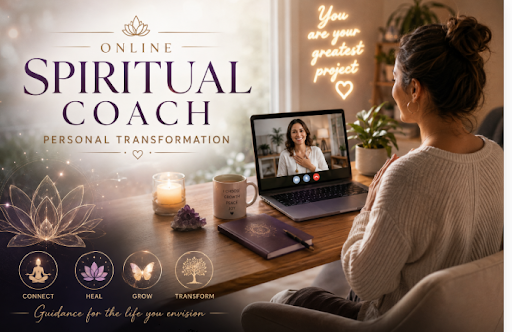
Thinking about working with an online spiritual coach but unsure what to expect? In this guide, you’ll learn how remote sessions work and what to expect from Darlene Coleman Coaching.

Online spiritual coaching provides a convenient space to explore personal goals, relationship challenges, and life changes. Sessions may incorporate hypnosis, NLP, EFT, and spiritual guidance based on your needs.

What Online Spiritual Coaching Actually Involves

Online spiritual coaching is a structured conversation that combines spiritual guidance with practical techniques tailored to your goals. You connect with your coach by video or phone and work through personal growth from the comfort of your own space.

Research on virtual health coaching has also found that remote coaching can support sustained behavior changes over time.

How a Remote Spiritual Coaching Session Is Structured

A typical online spiritual coaching session with Darlene Coleman Coaching starts with a quick check-in about how you are feeling that day and what has shifted since your last appointment.

From there, the session may include:

  • Focused conversation and spiritual mentoring
  • Breathing exercises or mindset shifts tailored to your current challenges
  • EFT (tapping), guided hypnosis, or simple energy-balance techniques, depending on your needs

You can follow Darlene’s instructions from your own space by video or phone. Sessions have a clear length and calm pace, with time at the end to integrate what you have learned and confirm your next step before you log off.

What Buyers Get Wrong When Choosing a Remote Coach

Online coaching is not automatically a weaker option than in-person support. The quality of the experience depends on the coach’s training, approach, and ability to provide structured guidance remotely.

Another common mistake is choosing a coach based only on inspirational content or social media presence. Before booking, check:

  • Relevant training and certifications
  • Testimonials and client experiences
  • Coaching methods and available modalities
  • How sessions are structured and supported between appointments

Taking time to evaluate these factors can help you choose an online spiritual coach who fits your goals and expectations.

What to Look for in an Online Spiritual Coach

Choosing the right online spiritual coach is partly about chemistry, but it is also about evidence. You are trusting someone with your personal story, emotional healing, and spiritual growth, so it is important to look beyond marketing claims and check for real credentials, lived experience, and a support structure that fits your life.

1. Credentials and Certifications

A strong online spiritual coach has visible, verifiable training in coaching and related modalities, not just informal experience. Darlene Coleman is a Professionally Certified Life Coach and an NCI (Neuro Change Institute) Certified Practitioner, with graduate training in holistic healing approaches.

These credentials show she has studied how change happens in the mind and nervous system and how to guide clients safely through that process in both in-person and remote formats.

2. Relevant Training and Experience

When choosing an online spiritual coach, look for relevant training, experience, and a clear approach to personal growth. Darlene Coleman combines professional coaching experience with training in hypnosis, NLP, and EFT to provide personalized guidance based on each client’s goals.

3. Availability of Accountability Between Sessions

Online coaching works best when you do not feel like you are on your own between calls. Darlene Coleman Coaching emphasizes personalized programs with accountability and support check-ins between appointments so you can ask questions, share progress, and receive guidance when life feels heavy between sessions.

This ongoing contact keeps your transformation work from feeling like a one-hour event and turns it into a continuous process supported by a coach who knows your story.

How Darlene Coleman Coaching Approaches Online Spiritual Coaching

When you work with Darlene Coleman Coaching as an online spiritual coach, you are not just getting conversation over video. You are entering a structured, holistic process that blends coaching, spiritual mentoring, and multiple healing modalities designed to support your whole self.

Darlene uses remote sessions to help you calm your nervous system, question limiting beliefs, and build new patterns of thought and behavior, drawing on both her training and personal experience.

You see the same attention, care, and depth you would in person, delivered in a way that fits your schedule and location.

The Multi-Modality Remote Process

Darlene Coleman’s approach combines spiritual support with techniques tailored to each client’s goals. Online sessions may incorporate:

  • EFT (Emotional Freedom Technique) for emotional and mindset support
  • Guided hypnosis to support focused personal change
  • NLP (Neuro-Linguistic Programming) to address unhelpful thought patterns
  • Spiritual guidance and mentoring to support personal growth and clarity

These methods can be adapted to remote sessions, allowing you to follow the guidance from your own space by video or phone.

What Clients Say About Working With Darlene

Clients describe Darlene’s approach as open, personal, and focused on meaningful change. Laura Holzler highlights Darlene’s honest dialogue and “transformative toolbox,” describing the experience as deeply satisfying.

This kind of personalized approach allows sessions to address the concerns that matter most to each client, whether the focus is personal growth, relationships, major life changes, or developing a clearer sense of direction.

Combined with techniques such as hypnosis, NLP, and EFT, the coaching process can give clients practical tools to continue working toward their goals between sessions.

Frequently Asked Questions

Q1. How does an online spiritual coaching session work?

An online spiritual coaching session is scheduled for a set time, and you meet your coach via secure video or phone.

You start with a check-in about how you are feeling and what you want to work on, then move into guided conversation, spiritual mentoring, and practical tools like EFT, hypnosis, or mindset exercises you can do from home.

The session closes with a short integration and next-step plan, so you know what to focus on between appointments.

Q2. Is online spiritual coaching as effective as in-person sessions?

For many clients, online spiritual coaching can be as effective as in-person work because the core elements are the same: a skilled coach, a safe relationship, and a clear process for working on your goals.

Virtual health coaching programs have shown that structured remote coaching can help participants maintain behavior change and improve quality-of-life outcomes over time.

Remote sessions give you more flexibility, reduce travel stress, and can feel safer when you are discussing sensitive topics, especially if you are a trauma survivor or caregiver balancing a busy schedule.

The key is choosing a coach with proven training, lived experience, and a structured approach rather than focusing only on the format.

Q3. What do I need for a remote session with Darlene Coleman Coaching?

You will need a quiet, private space where you feel comfortable speaking openly, a reliable internet connection if you are using video, and basic headphones or speakers so you can hear clearly. It helps to have a notebook or journal nearby to capture insights or exercises Darlene suggests.

Being in a place where you can close your eyes and relax, without interruption, makes modalities like EFT or guided hypnosis more effective.

Q4. Can an Online Spiritual Coach Help With Relationship Challenges?

Yes. Online spiritual coaching can provide a private, convenient space to explore relationship challenges, communication patterns, and personal goals.

Depending on your needs, Darlene Coleman Coaching may incorporate techniques such as hypnosis, NLP, EFT, and spiritual guidance to help you gain clarity and approach relationship decisions with greater confidence.

Q5. How much does online spiritual coaching cost?

The cost of online spiritual coaching depends on the type of support and services selected. Darlene Coleman Coaching offers personalized guidance based on individual goals, with approaches that may include hypnosis, NLP, EFT, and spiritual mentoring.

For current session pricing and package options, contact Darlene Coleman Coaching directly to discuss the available options.

Ready To Explore Online Spiritual Coaching?

An online spiritual coach can provide personalized guidance for relationship challenges, life changes, and personal growth from the comfort of your own space. Darlene Coleman Coaching combines spiritual guidance with hypnosis, NLP, and EFT to help you move forward with greater clarity and confidence.

Ready to explore what online spiritual coaching can offer? Book a free discovery call with Darlene Coleman Coaching and discuss your goals today.

Leave a Reply

Your email address will not be published. Required fields are marked *

A headshot of Darlene Coleman

You may also enjoy:

This gathering will meet from 7:30pm to 8:30pm. Just click the link to join.

This gathering will meet from 7:30pm to 8:30pm. Just click the link to join.

This gathering will meet from 7:30pm to 8:30pm. Just click the link to join.

This gathering will meet from 7:30pm to 8:30pm. Just click the link to join.

Thanks for Subscribing!

As a gift to you for subscribing, click the link below to download my Daily Guide

“Nobody can “treat” a war, or abuse, rape, molestation, or any other horrendous event, for that matter; what has happened cannot be undone. But what can be dealt with are the imprints of the trauma on body, mind, and soul: the crushing sensations in your chest that you may label as anxiety or depression; the fear of losing control; always being on alert for danger or rejection; the self-loathing; the nightmares and flashbacks; the fog that keeps you from staying on task and from engaging fully in what you are doing; being unable to fully open your heart to another human being.

The challenge of recovery is to reestablish ownership of your body and your mind — of your self. This means feeling free to know what you know and to feel what you feel without becoming overwhelmed, enraged, ashamed, or collapsed. For most people this involves (1) finding a way to become calm and focused, (2) learning to maintain that calm in response to images, thoughts, sounds, or physical sensations that remind you of the past, (3) finding a way to be fully alive in the present and engaged with the people around you, (4) not having to keep secrets from yourself, including secrets about the ways that you have managed to survive.”

– Bessel Van Der Kolk, MD

First Responder Support

Being a first responder has its own unique challenges. As a former Paramedic/Firefighter, I understand those challenges and use a variety of tools and techniques to help process the stress that comes with the job. **I also offer my S.T.A.R. Program; Tools and Techniques to modulate your internal Stress, Trauma, and Anxiety Response, which I offer to Fire Departments locally as well as across the country. If you are interested, please contact me directly.
Link to PTSD in First Responders:
I wish my head and body could forget the things my eyes have seen –

Self-Care Coaching Package

Caregiving can challenge the most resilient among us. If youve found yourself in the role of caregiver, feelings of overwhelm and stress are quite common. 

You may be feeling sad, irritable, angry, or depressed. You could be suffering from exhaustion or weight gain. The constant strain and worry can cause headaches or other physical symptoms which could then lead to self-medicating with alcohol, drugs, or unhealthy foods. 

In short, high levels of stress over a long period of time can have serious and long-lasting effects on both your mental and physical health.

However, you may be so focused on your loved one that you don’t realize your own health and well-being are suffering, and the thought of doing something for you can feel selfish. 

Now is the time when you need it the most.

Some of the best strategies as a caregiver are to accept help, find connection, and get support.

My Self-Care Coaching Package can provide that! 

Click on the following link for information about my group coaching package for caregivers

For Parkinson’s Caregivers, you may also join 
parkinsonslifestylemanagement
which is an informational site on the management of Parkinson’s disease.

Reiki

Rei-Ki: The word translated means “life-force-energy”.  There are many different names for this life force and energy field we exist within such as; Chi, Prana, Qi, Higher Power, God force- in other words, spiritually guided life force energy.  It is administered by “laying on hands” in a variety of placements and is commonly used for stress reduction and relaxation and can also promote healing. 

Reiki is a very calming therapy and is performed with you lying on a massage table, fully clothed in a pleasing environment.  Essential oils, Tibetan singing bowls, and guided visualization are also used during your session to enhance the relaxation process.  

If you find yourself regularly stressed out, Reiki may be the therapy for you. 

Spiritual Support

When you are wanting expansion in your spiritual consciousness. These sessions are based and centered on the exploration of the ego, and include reading assignments. Phone sessions are also available.

B.A.U.D. RESET TRAUMA THERAPY

The BAUD is a sound based device that helps to disrupt the circuits of Trauma that get held in the nervous system of the brain and body. It is helpful with a variety of different personal issues.

Professional Speaking

If you’d like me to speak at one of your events, please contact me directly. I speak on a variety of topics all centered around living your best life.

Hypnosis

When people hear the word “hypnosis”, they immediately think of swinging watches, spinning spirals and mind-control that they see in the movies.  While it can be, it’s not really like that.

Hypnotic trance exists in many different forms in everyday life, for example when you are watching your favorite TV show or reading a good book or daydreaming.  We become hypnotized all of the time without our awareness, into particular mindsets. Many of these mindsets are created when we are children and learning to navigate the world around us. Powerful post-hypnotic suggestions can stay with us for years, especially in areas where self-esteem is concerned.  Often, the job of the therapist is to de-hypnotize the client.  

I am certified in “Ericksonian” style hypnosis, which uses more of what it is called indirect suggestions. Indirect suggestions are much harder to resist because they are often not even recognized as suggestions by the conscious mind.  

Hypnosis helps to open and relax the mind, works on many different topics and enables a space for healing to occur.

Neuro-Linguistics (NLP)

Your words and thoughts are powerful.  Very powerful.  This isn’t speculation; it is a reality. 

The basic premise of NLP is focused on the “language” of our thoughts and how that language is stored in the brain. The specific language we use reveals our inner, subconscious perceptions or beliefs around our problems and the world at large. If our language and our perceptions are inaccurate, as long as we continue to talk and to think in that same way, the underlying problems will persist. In other words, our attitudes are, in a sense, a self-fulfilling prophecy and a way of remaining stuck.  Our words and thoughts create our own version of reality.

“The phrase “Neuro-Linguistic Programming” describes the process of how personality creates and expresses itself. Put simply, we are all made up of a neurology that conveys information about our environment to our central nervous systems and brains. Since we are also meaning creating creatures, we translate these perceptions in our brains into meanings, beliefs and expectations. As we continue to grow from a rather infant brain into a more complex adult human, we tend to filter, distort and magnify the input we get from our environment such that it matches the elaborate program we evolve to explain our life experience.”  -Wikipedia

In the early 70’s a man named Richard Bandler, decided for his thesis project that he wanted to develop models of human behavior to understand why certain people seemed to be excellent at what they did, while others found the same tasks challenging or nearly impossible to do.  Along with his then professor, John Grinder, and using inspiration by pioneers in the fields of therapy and personal growth, they began to develop systematic procedures and theories that formed the basis of NLP. They studied three top therapists: Virginia Satir, the extraordinary family therapist, who consistently was able to resolve difficult family relationships that many other therapists found intractable, the innovative psychotherapist Fritz Perls, who originated the school of therapy known as Gestalt, and Milton Erickson, the world-famous hypnotherapist.

“Their goal was to develop models of how it was that these people got the results they did. They sought to identify and model the patterns that produced these results and then to teach these models to others. These three gifted therapists were quite different personalities, yet Grinder and Bandler discovered some underlying patterns that were quite similar. These patterns became the underlying structure of NLP, with names such as meta-model, sub-modalities, reframing, language patterns, well-formed conditions and eye accessing clues.”

NLP allows you to change the language and beliefs that you are holding, thereby allowing you to create new, healthier, productive patterns.

Emotional Freedom Technique (EFT)

When you first hear about EFT you may find yourself feeling skeptical at first…until you experience it. EFT is a meridian based therapy that some texts say has been around in one form or another for thousands of years and is used to help neutralize fear based emotions. At the most basic of all levels, the building blocks of life, our bodies are comprised of systems of energy. Every thought you have has an electromagnetic or energetic consequence, creating physical symptoms in the body. The basic premise of EFT is that the cause of all negative emotion is a disruption of the body’s energy field. To better understand how EFT works you would first need to know a little about the brain. If you were to think of the organ of the brain itself, it would be like the hard drive in your computer. Every time you have a thought, especially one where a negative emotion is attached, it’s like loading software onto your brain, and a neural pathway or program is formed. These negative thoughts land in a part of the brain known as the “amygdala”, the part of the brain associated with fear. Over time, these pathways become bigger and stronger until they form patterns and become part of your sub-conscious. Before long, these unconscious fear based programs become a filter through which you see and live your life. Research has shown that by tapping on the energy meridians of the body while associated into a particular feeling, a signal disruption occurs, and a neutralizing effect happens. New, healthier pathways are created, and a cessation of anxiety is experienced. This technique has been shown to be especially effective when used on PTSD patients. A special technique called “Tearless Trauma” allows one to process and experience a release around particularly traumatizing events, without necessarily having to rehash painful details. In a critical review published in the American Psychological Association’s (APA) journal Review of General Psychology last year, researchers found that EFT “consistently demonstrated strong effect sizes and other positive statistical results that far exceed chance after relatively few treatment sessions.”

video
 
For Research:

EFT Research

National Library of Medicine


Life Coaching

The coaching process is a focused conversation in combination with different techniques designed to move you out of your state of confusion, limitation or fear, to where you aspire to be. It does so by addressing specific personal or business goals, analyzing general conditions such as emotional and physical health or addictions, as well as relationships or transitions in the client’s personal life. Through close examination, I help you discover what your obstacles or challenges might be, then choose a course of action to make your life become what you want it to be. A variety of modalities are included in this process.

Privacy Overview

This website uses cookies so that we can provide you with the best user experience possible. Cookie information is stored in your browser and performs functions such as recognising you when you return to our website and helping our team to understand which sections of the website you find most interesting and useful.