
Personal Growth Coach vs Wellness Coach: Which Fits Your Divorce Recovery?

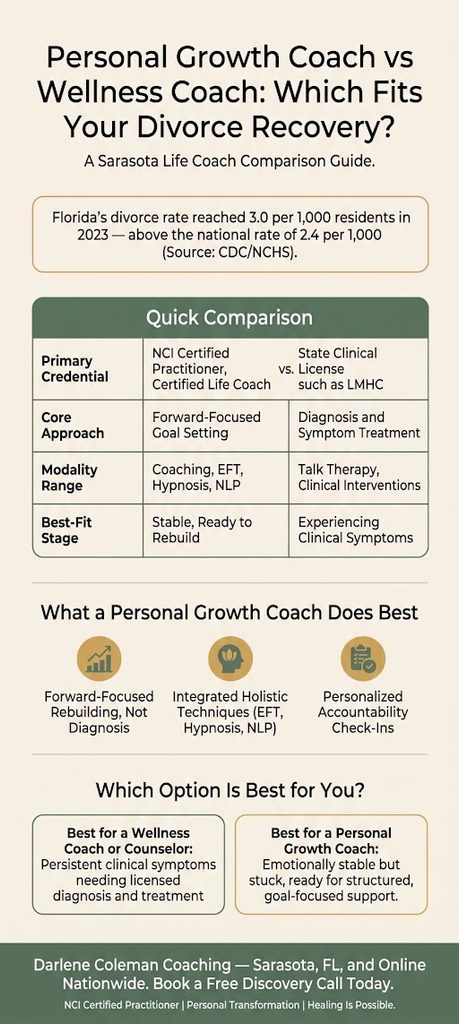
Finding the right support after divorce can be difficult, especially when you are choosing between a personal growth coach, counselor, or wellness practitioner. According to the CDC’s National Center for Health Statistics, Florida recorded 3.0 divorces per 1,000 residents in 2023, compared with 2.4 nationally.
In this guide, you’ll learn how a personal growth coach differs from other support options and which approach may best fit your goals as you move forward after divorce.
Quick Comparison: Personal Growth Coach vs. Wellness Coach
Quick Answer: A personal growth coach and a wellness coach differ most in credentials, session structure, and whether divorce is treated as a life transition or a clinical condition.
Side-by-Side Comparison Table
This table shows how a personal growth coach compares to a wellness coach or counselor across the criteria that matter most for divorce recovery.
| Focus Area | Personal Growth Coach | Wellness Coach/Counselor |
| Primary credential | NCI Certified Practitioner, Certified Life Coach | State clinical license (for example, LMHC) |
| Core approach | Forward-focused goal setting | Diagnosis and symptom treatment |
| Session structure | Flexible, personalized coaching plan | Structured clinical treatment plan |
| Modality range | Coaching, EFT, hypnosis, NLP | Talk therapy, clinical interventions |
| Best-fit divorce stage | Stable, ready to rebuild | Experiencing significant clinical symptoms |
| Delivery format | In-person in Sarasota, FL, or online nationwide | Varies by provider and license |
What a Personal Growth Coach Does Best
Quick Answer: A personal growth coach helps you move from feeling stuck after divorce to feeling clear, capable, and ready for your next chapter, without treating your transition as a diagnosis.
Forward-focused rebuilding, not diagnosis
A personal growth coach starts from where you are today and works toward where you want to be next. Instead of assigning a diagnosis, your coach helps you identify what confidence, clarity, and stability look like for you after divorce.
Sessions center on your goals, your patterns, and your next decisions, not a symptom checklist. This forward-focused structure works well when you are stable enough to actively rebuild your life rather than manage ongoing clinical symptoms.
Integrated holistic techniques: EFT, hypnosis, and NLP
Darlene Coleman Coaching layers multiple techniques into one personal development coaching relationship. Emotional Freedom Technique (EFT) helps calm the nervous system during stressful moments, such as court dates or difficult conversations with an ex-spouse.
A 2025 systematic review published in PubMed Central, part of the National Institutes of Health, found that EFT contributed to reduced anxiety and related psychological symptoms across multiple clinical trials.
Hypnosis supports deeper mental reframing around limiting beliefs from the relationship or marriage. The NIH National Center for Complementary and Integrative Health reports that hypnosis has been studied for state anxiety, stress-related symptoms, and post-traumatic stress.
Neuro-Linguistic Programming (NLP) helps you notice and shift communication and thought patterns that keep you stuck. Together, these techniques give you more than one path forward when a single method is not enough.
Personalized accountability check-ins between sessions
You do not have to wait weeks between appointments to get support. Darlene Coleman Coaching builds accountability check-ins into the coaching relationship, so you stay on track between sessions instead of losing momentum during a major life transition.
Clients describe this ongoing support as a major part of what makes the coaching work, especially during the unpredictable early months of a divorce.
Client testimonial, Lisa, Sarasota, FL:
“I have worked closely with Darlene Coleman for the past five years and hold her in the highest regard. Darlene is a talented & gifted life coach and healer who has assisted me enormously over the past several years through major changes, including a protracted divorce and career change.”
This kind of personalized attention is central to how a personal growth coach supports divorce recovery over time.
What a Wellness Coach or Counselor Offers
This section explains how a wellness coach or counselor differs from a personal growth coach in practice.
How This Approach Works
A wellness coach or licensed mental health counselor typically works from a clinical framework.
The Florida Board of Clinical Social Work, Marriage and Family Therapy, and Mental Health Counseling requires a master’s degree, supervised clinical hours, and a state exam before someone can practice as a Licensed Mental Health Counselor (LMHC) in Florida.
Many counselors treat divorce as a diagnosable condition alongside concerns like anxiety, depression, or codependency, using a structured treatment plan tied to clinical goals. This model works well for people experiencing significant clinical symptoms that require a licensed provider.
A personal growth coach takes a different, forward-focused approach that does not rely on a clinical diagnosis.
The Key Differences That Matter
Quick Answer: The real difference is not price or personality; it is whether you need a diagnosis-based treatment plan or a forward-focused personal growth coach partnership.
Diagnostic treatment vs. forward-focused coaching
Wellness coaches and counselors often treat divorce as a condition to diagnose and manage. Yes, that clinical structure genuinely helps people with significant symptoms, but it usually is not designed for someone who is emotionally stable and simply ready to rebuild.
A personal growth coach works from a different model: partnering with you on your present situation and future goals rather than diagnosing a disorder.
Under Florida Statute 491, mental health counseling is a regulated clinical profession with specific education and licensing requirements, a scope that coaching intentionally stays outside of.
Single-modality support vs. combined coaching techniques
Yes, standard counseling offers one consistent therapeutic method, and that consistency matters for some clients. But it usually means less flexibility when you respond better to a different technique.
Darlene Coleman Coaching combines EFT, hypnosis, and NLP inside one coaching relationship, tailored to how you personally process change.
Which Option Is Best for You?
Choosing between a wellness coach or counselor and a personal growth coach depends on where you are in your divorce recovery right now.
Best For a Wellness Coach or Counselor
Best for someone experiencing persistent clinical symptoms, such as ongoing depression, panic attacks, or trauma responses, who needs a licensed provider to diagnose and treat those symptoms directly.
Best For a Personal Growth Coach
Best for someone who feels emotionally stable but stuck after divorce and wants structured, goal-focused support combined with holistic techniques to rebuild confidence and direction.
Frequently Asked Questions
Q1. How is a personal growth coach different from a divorce therapist?
A personal growth coach focuses on your present goals and future direction, using coaching conversations and holistic techniques like EFT and NLP. A divorce therapist or counselor diagnoses and treats clinical symptoms, such as depression or trauma, under a licensed treatment plan.
Q2. Can a personal growth coach help if I am not in therapy?
Yes. Personal growth coaching works well for people who feel emotionally stable and ready to move forward, not for people who need clinical diagnosis or treatment for ongoing symptoms.
If you are managing significant symptoms, a licensed counselor may be the right first step, and coaching can complement that care once you are stable.
Q3. Does Darlene Coleman Coaching offer online coaching for divorce recovery?
Yes. Darlene Coleman Coaching offers in-person sessions in Sarasota, FL, and remote coaching for clients nationwide, so you can get consistent support wherever you live.
Q4. What techniques does Darlene Coleman Coaching use for divorce recovery?
Sessions can include life coaching conversations, EFT, hypnosis, and NLP, combined into a personalized plan based on what you need at each stage of your recovery.
Choose Support That Matches Your Next Chapter
Divorce can leave you unsure about what comes next. If you feel ready to move forward but need greater clarity, confidence, and direction, working with a personal growth coach can give you structured support as you build your next chapter.
Ready to move forward with greater clarity and confidence? Schedule a free discovery call with Darlene Coleman Coaching to explore personalized coaching in Sarasota, FL, or online nationwide.