
Emotional Healing Coach: The Real B.A.U.D. Technique Behind Letting Go

Most people only look for an emotional healing coach after months of feeling stuck in the same reaction, the same argument, or the same fog of overthinking. By then, the pattern has already shaped their relationships, their sleep, and their confidence.
A single technique rarely untangles all of that at once. This article explains how the B.A.U.D. technique works alongside EFT, hypnosis, and NLP and what a real session looks like before you book one.
Quick Answer: An emotional healing coach who combines B.A.U.D. with EFT, hypnosis, and NLP addresses emotional patterns from several angles instead of relying on one method alone.
What an Emotional Healing Coach’s B.A.U.D. Session Actually Involves
Quick Answer: A B.A.U.D. session focuses on identifying a specific emotional pattern, then using guided techniques to interrupt and reshape how the nervous system responds to it.
1. Core process
A session starts with naming one specific pattern, not a vague sense of stress. The coach works with you to identify when the pattern shows up, what triggers it, and how your body responds in that moment.
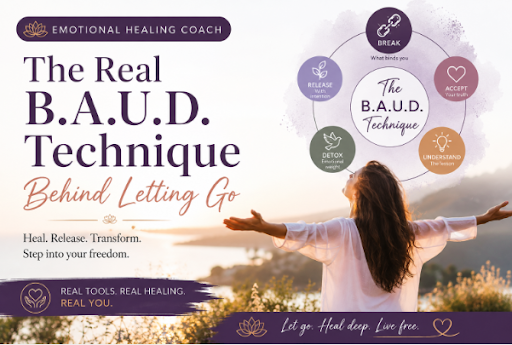
From there, B.A.U.D. uses guided bilateral stimulation to help the nervous system process the emotional charge attached to that pattern. This happens instead of just talking about the pattern in the abstract.
2. How B.A.U.D. works alongside EFT, hypnosis, and NLP
Most hypnotherapy and coaching sites describe one technique in isolation. What is rarely explained anywhere is how these methods work together in the same session.
EFT taps into acupressure points to calm the body’s stress response while a pattern is being addressed. Hypnosis then supports a state where the mind opens more easily to shifting the automatic reaction tied to that pattern.
NLP reframes the language and internal story around the event. B.A.U.D. ties these together by giving the nervous system a structured way to release the charge, rather than just intellectually understanding it.
3. What buyers get wrong when choosing
Many people assume any coach who offers emotional healing uses the same process. In reality, a coach trained in only one modality can only address one layer of the pattern. Someone trained across multiple techniques can move between them depending on what a specific session calls for.
What to Look for in an Emotional Healing Coach
Quick Answer: The right emotional healing coach combines verified credentials, a range of techniques, and a flexible session format that fits your schedule and comfort level.
1. Certification and qualification standard
Look for a coach with a verifiable credential, not just a title. Darlene Coleman Coaching holds certification as an NCI Certified Practitioner through the NeuroChange Institute, which reflects formal training behind the techniques used in session.
2. Range of techniques offered
A coach who only offers hypnosis can help with relaxation and suggestion work. That coach cannot layer in the acupressure-based calming of EFT or the structured reset of B.A.U.D. when a session calls for it.
Ask directly which techniques a coach is trained in and how they decide which one to use during a session.
3. Personalized, flexible session structure
Sessions should be tailored to your specific pattern, not a scripted routine repeated for every client. Darlene Coleman Coaching offers both in-person sessions in Sarasota, Florida, and remote sessions for clients across the United States.
Location does not have to limit access to this kind of work when remote sessions are available.
How Darlene Coleman Coaching Approaches Emotional Healing
Quick Answer: Darlene Coleman Coaching blends B.A.U.D. with EFT, hypnosis, and NLP into one adaptable process built around each client’s specific pattern.
An emotional healing coach who works across B.A.U.D., EFT, hypnosis, and NLP can shift a session in real time based on what a client actually needs that day.
Instead of following one fixed script, the coach moves between techniques, calming the nervous system with EFT, deepening focus with hypnosis, and reshaping internal language with NLP, while B.A.U.D. gives the whole process a structured reset point.
1. Darlene’s specific process
Each session begins by identifying the exact emotional pattern at play, then selecting the combination of techniques that fits that pattern. This flexibility is part of what separates an integrated approach from single-method hypnotherapy or coaching.
2. Proof point and outcome
Clients describe tangible shifts after working through this process. Stephen Schlabach shared: “Darlene is like a Swiss Army knife, packed with tools that help you figure out where you are and unlock the awareness to live the life you truly love.”
Greg Crawford added: “She has helped me in multiple ways. My mindset, my clarity, and my business.”
A 2025 study on a single Emotional Freedom Techniques session found moderate improvements in most measured outcomes, pointing to its potential role in psychological recovery (Stapleton et al., Taylor & Francis, 2025).
A 2026 integrative review in Behavioral Sciences described hypnosis as a mechanism that supports emotion regulation and self-integration, not simply relaxation (Gallardo, Behavioral Sciences, 2026).
Frequently Asked Questions
Q1. What is the B.A.U.D. technique used for?
B.A.U.D. is a guided technique that helps the nervous system process and release the emotional charge attached to a specific pattern, using bilateral stimulation to support the shift.
Coaches often combine it with EFT, hypnosis, or NLP depending on what the session requires and how the client responds in the moment.
Q2. How is an emotional healing coach different from a therapist?
An emotional healing coach focuses on tools, techniques, and forward movement rather than clinical diagnosis or treatment. Coaching works alongside, not in place of, licensed mental health care when that support is also needed.
Q3. How many sessions does it take to see results?
This depends on the specific pattern being addressed and how long it has been in place. Some clients notice shifts within the first few sessions, while others need a longer series to fully rework a long-standing response.
Q4. Can emotional healing coaching be done online?
Yes. Darlene Coleman Coaching offers remote sessions for clients across the United States, in addition to in-person sessions at its Sarasota, Florida, location. Both formats use the same combination of B.A.U.D., EFT, hypnosis, and NLP, so distance does not limit which techniques are available to you.
Q5. Is the B.A.U.D. technique uncomfortable?
Most clients describe the process as calming rather than uncomfortable. The coach guides and paces the technique to match what feels manageable in each session, rather than forcing a reaction.
Wrapping Up!
If the same emotional patterns continue to affect your relationships, confidence, or daily life, personalized support can help you take a different approach. Darlene Coleman Coaching combines hypnosis, NLP, EFT, and B.A.U.D. to create a session focused on your specific goals and needs.
Book your free discovery call with Darlene Coleman Coaching to discuss what you’re experiencing and find the right next step.