
Hypnosis for Stress Management: What to Actually Expect From Your Coach

Most people only look for help with stress once it has started to affect their sleep, focus, and relationships. By then, the idea of trying something unfamiliar like hypnosis can feel intimidating instead of hopeful.
If you are considering a stress management coach, understanding what to expect can make the process feel more approachable.
This article explains what actually happens in hypnosis for stress management so you can decide, with clear information, whether working with a qualified coach is the right next step for you.
What hypnosis for stress management actually involves
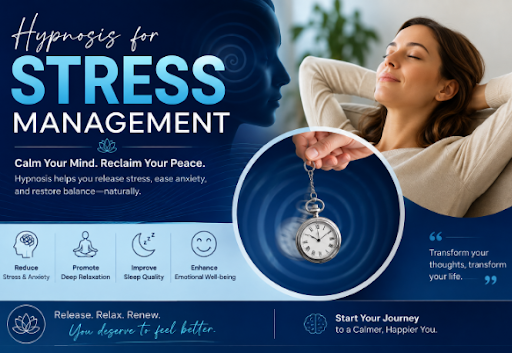
Hypnosis for stress management is a guided process that helps you access a more relaxed, focused state so you can change how your mind and body respond to everyday pressure.
Instead of looking like stage hypnosis, it feels more like a calm, collaborative coaching session where you stay fully aware and in charge the whole time.
What a real session looks like, step by step
A typical hypnosis session for stress with a qualified coach begins with a short conversation about what triggers your stress, how it affects you, and what you want to feel instead. You and your coach clarify your goals and agree on what you are comfortable working on that day.
From there, you sit or recline comfortably while your coach guides you into a focused, relaxed state using calm voice cues, breathing, and simple imagery. During this process:
- You hear every word and can move or speak if needed.
- You remain in control of what you choose to accept or ignore.
- The experience may feel similar to being absorbed in a good book or movie while still knowing where you are.
Once you reach that relaxed state, the coach uses carefully chosen suggestions and mental rehearsal to help you respond differently to everyday stressors. This might include:
- Practicing how you want to react in a difficult meeting.
- Gently releasing physical tension.
- Softening a recurring worry that keeps you on edge.
The session usually ends with a gentle return to normal alertness and a brief debrief, helping you connect the hypnosis experience with simple steps to use during the week.
What people get wrong before trying hypnosis
A common misconception is that hypnosis means going under or handing over control to someone else. In reality, hypnosis is a cooperative process: you cannot be made to do anything against your values, and you can open your eyes or stop at any point.
Another myth is that hypnosis is only for severe problems or dramatic stage-show demonstrations. In practice, hypnotherapy is often used as a supportive way to reduce perceived stress, improve coping skills, and support emotional regulation for everyday life challenges, not just major events.
Many people find that it becomes one of several tools they use to manage pressure at work, at home, or during big life changes.
What to look for in a hypnosis coach for stress management
Choosing the right hypnosis coach protects your time, your trust, and your results when you are already feeling stretched thin. A few clear criteria can help you move from guessing to making a confident, informed decision about who you work with.
The best hypnosis coaches for stress management combine formal training, clear methods, and real-world experience with people whose lives are already under pressure.
In Sarasota, that often means looking beyond generic wellness labels and focusing on practitioners who can show you both credentials and a concrete process for how they approach stress.
1. Certification and credentials
Hypnosis is not just about having a soothing voice. You want someone who has invested in learning the mind-body methods they use.
At Darlene Coleman Coaching, Darlene is a Professionally Certified Life Coach and a graduate of Bennett-Stellar University, with a specialty in NeuroLinguistics, EFT, Energy Balance Healing, and Neurofeedback.
She is also an NCI (Neuro Change Institute) Certified Practitioner, reflecting advanced study in how belief and mindset shifts support lasting change.
When you interview any hypnosis coach, ask where they trained, what specific modalities they are certified in, and how those methods are applied in stress work. A qualified practitioner will be able to answer clearly, in plain language, without hiding behind vague phrases or confusing jargon.
2. A multi-modality approach, not just one technique
Stress rarely has a single cause, so it often responds best to more than one tool. Darlene Coleman Coaching brings together hypnosis, NLP (Neuro-Linguistic Programming), EFT (Emotional Freedom Technique), and energy balance work in one coaching framework.
That means your sessions can be tailored dynamically: some days may lean more on deep relaxation and hypnotic imagery, while others focus on shifting the self-talk and mental pictures that keep stress looping in your mind.
This multi-modality approach sets Darlene apart from single-technique providers who offer only hypnotherapy in isolation.
Instead of forcing every problem through the same method, Darlene can choose the right combination for how your stress shows up that week, whether it is racing thoughts, muscle tension, or difficulty letting go of a specific situation.
3. Experience across a range of high-stress lives
Credentials matter, but so does lived experience with people whose lives are already full and demanding. Darlene has worked with medical and business professionals, athletes, and women navigating major life transitions like divorce or career changes.
That breadth of experience means she understands how stress can be both external pressures and internal patterns, and she structures hypnosis sessions to respect the realities of your schedule and energy.
For you, that translates into practical strategies you can use between sessions, not just a relaxing hour you forget the moment you walk out the door.
How Darlene Coleman Coaching approaches hypnosis for stress management
Working with Darlene Coleman Coaching gives you access to a clear, repeatable process for using hypnosis to ease stress, rather than a one-time quick fix.
From the first conversation, you know what will happen in each session, how long it will take, and how hypnosis fits with tools like NLP and EFT to support real change over time.
1. Darlene’s specific process
Your work with Darlene typically begins with a detailed conversation about how stress affects your daily life and what you want to feel instead.
Drawing on her background in NeuroLinguistics and Energy Balance Healing, she helps identify the thought patterns, triggers, and nervous-system cues that keep you stuck.
During a hypnosis-focused session, Darlene guides you into a relaxed, focused state using her voice, breathing cues, and simple imagery. She then integrates gentle hypnotic suggestions with NLP techniques to help you:
- Reframe stressful situations
- Rehearse calmer responses
- Recognize recurring thought patterns
EFT tapping or other energy-balance techniques may be used before or after the hypnosis work to help address lingering tension.
As an NCI-Certified Practitioner and Bennett-Stellar graduate, Darlene’s process draws on formal training and years of applied practice while keeping your specific stress goals at the center of each session.
2. What the research says about outcomes
Darlene’s approach aligns with a growing body of research on hypnosis for stress and anxiety. In one randomized controlled trial of people with elevated perceived stress, group hypnosis sessions led to significantly reduced stress levels over several weeks compared with a control group.
A separate review of hypnosis for perceived stress found positive effects in most of the analyzed studies while noting that methods and outcome measures still vary between trials.
More recently, a large-scale study of app-delivered self-hypnosis for stress found that regular use of brief hypnotic sessions was associated with meaningful reductions in self-reported stress over time.
These findings do not guarantee results for any individual, but they support what many clients experience in practice: hypnosis can be a helpful, non-pharmacological way to change how you respond to ongoing pressure when it is used as part of a structured program.
Frequently asked questions
Q1. What does hypnosis for stress feel like?
Most people describe hypnosis as feeling deeply relaxed and focused at the same time. Your body may feel heavier or lighter, your breathing slows, and your attention narrows to the coach’s voice while background noise fades into the distance.
You do not lose awareness or control; instead, you feel more absorbed in your inner experience, similar to being caught up in a good book while still able to move or speak if you choose.
Q2. How many hypnosis sessions do I need to see results in stress management?
The number of sessions depends on how long stress has been building and how many areas of your life it affects. Some people notice small shifts after a handful of sessions, while others benefit from a longer coaching relationship that addresses deeper patterns and recurring triggers.
In many clinical studies on hypnosis for perceived stress, programs are structured over several weeks rather than a single visit, which is a useful guide for setting expectations rather than hoping for an instant fix.
Q3. Is hypnosis safe, and will I lose control during a session?
When practiced by a properly trained professional, hypnosis is considered a safe approach for many stress-related concerns.
Reviews of the clinical and medical use of hypnosis describe it as a non-addictive technique that has been used for decades in healthcare settings, particularly for anxiety and procedure-related stress.
You do not lose control during a session: you hear everything, you can reject any suggestion that does not feel right, and you can stop at any time by opening your eyes or speaking up.
Q4. Can hypnosis be combined with NLP or EFT for stress relief?
Yes. Combining hypnosis with NLP and EFT can give you more ways to work with stress than hypnosis alone. At Darlene Coleman Coaching, hypnosis sessions are often integrated with NLP techniques to shift unhelpful thought patterns and with EFT to release emotional tension through gentle tapping on specific points.
This layered approach allows you to address both the mental stories that keep stress alive and the physical sensations that make it so draining within one coordinated coaching plan.
Q5. How is hypnosis different from meditation for managing stress?
Meditation usually invites you to observe your thoughts without judgment and gently return your focus to the present moment. Hypnosis also uses relaxation and focus, but it adds targeted suggestions and mental rehearsal aimed at specific changes in how you respond to stress.
In hypnosis, you and your coach agree on clear outcomes before you begin so the session can guide your mind toward those outcomes more directly while you are still feeling calm and supported.
Conclusion and next steps
Managing ongoing stress does not have to mean relying on the same strategies that have not worked. Hypnosis, NLP, and EFT can provide additional tools for building calmer responses and managing everyday pressure.
Ready to explore a personalized approach? Contact Darlene Coleman Coaching to book a free discovery call and find out whether hypnosis for stress management is right for you.