

Spiritual Growth Coach vs. Going It Alone: Which Is Right for You


If you are considering a spiritual growth coach, you may wonder whether professional guidance adds enough value to justify the time and cost. Self-guided growth offers flexibility, while coaching adds structure, accountability, and an outside perspective.
In this guide, you will compare both approaches, including their costs, benefits, and limitations, so you can decide which fits your goals and current needs.
Quick Comparison: Spiritual Growth Coach vs. Going It Alone
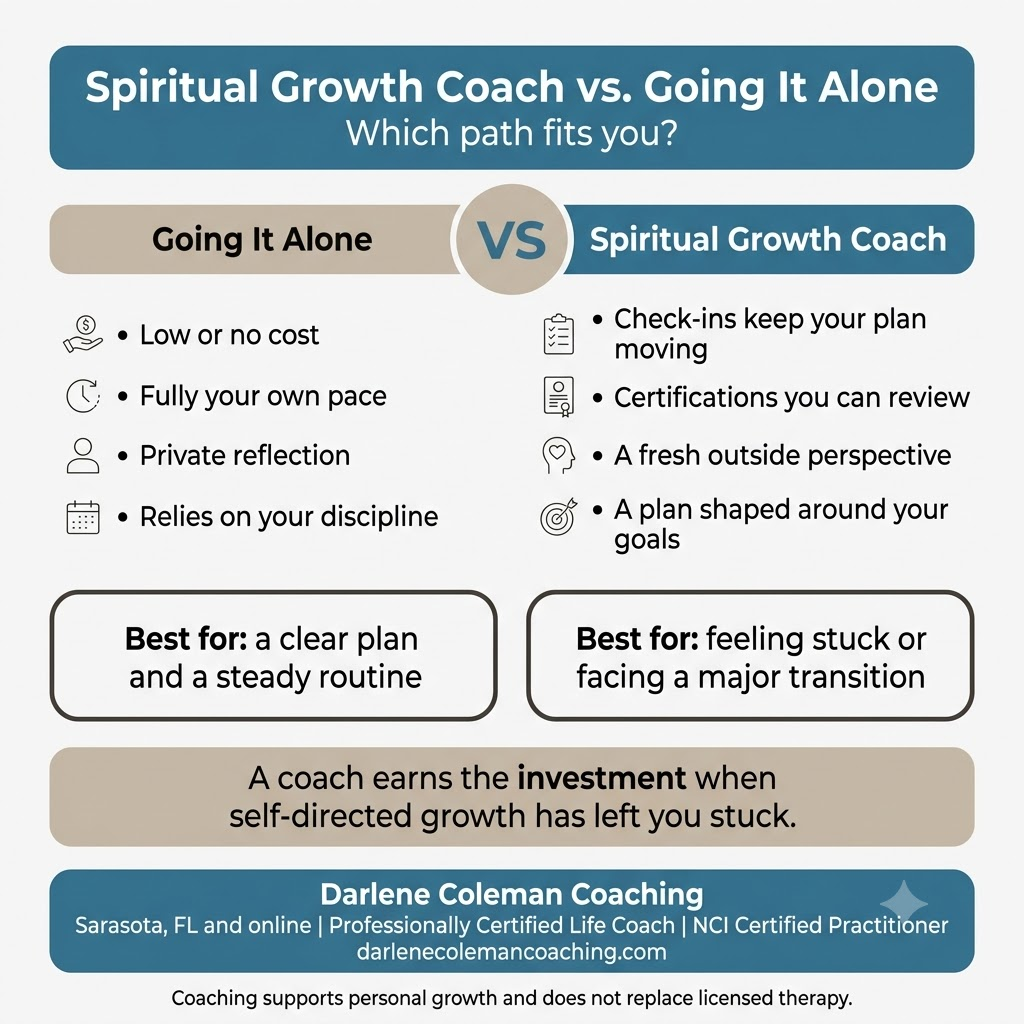
Self-guided growth wins on cost and flexibility, while a coach wins on accountability, verifiable qualifications, and an outside perspective, as the table shows.
| Criterion | Spiritual growth coach | Going it alone |
|---|---|---|
| Accountability between sessions | Check-ins keep your plan moving | Depends on your own discipline |
| Qualifications you can verify | Certifications you can review | None to review |
| Cost in money and time | Session fees, plus a plan shaped around your goals | Low or no cost, but more hours spent planning |
| Flexibility and pace | You and the coach agree on the schedule | Fully yours |
| Outside perspective | A coach can point out patterns you overlook | Limited to your own view |
What Darlene Coleman Coaching Does Best as a Spiritual Growth Coach
Darlene Coleman Coaching pairs spiritual support and mentoring with professional life coaching, and Darlene holds verifiable credentials and checks in between appointments.
A spiritual growth coach guides your inner growth with personal accountability and practical tools. At Darlene Coleman Coaching, spiritual support sessions center on exploring the ego, include reading assignments, and are also available by phone. Life coaching adds self-awareness, responsibility, and action.
Accountability Between Appointments Keeps Your Plan Moving
Sarasota life coach Darlene Coleman builds personalized programs with support and accountability check-ins between appointments. Her packages include mid-week check-ins by text or email. That structure helps most when motivation dips and nobody else is watching.
Client Genna Bennett Soh wrote in a Google review that Darlene “has helped me gain new perspectives and to set new goals towards what I really want in life.” Henry Rodriguez, a coaching client for several years, wrote that he has “implemented several of her many tools.”
Qualifications You Can Check Before You Book
Darlene is a Professionally Certified Life Coach, an NCI-Certified Practitioner through the Neuro Change Institute, and a graduate of Bennett-Stellar University. Her coaching services page provides more details about her background and client reviews.
73% of coaches agree that clients and organizations expect them to hold a coaching certification or credential, according to the ICF Global Coaching Study.
Use that expectation as a fair test for any coach you consider. Each credential also gives you a specific question to ask in a first conversation.
Lived Experience Plus Holistic Tools in One Coaching Plan
Darlene combines professional life coaching with three holistic tools. EFT is an energy-based emotional wellness technique. N.L.P. focuses on thought patterns and communication. Reiki offers relaxation sessions. These are wellness practices, not medical treatments.
Her background as a former US Marine and a paramedic and firefighter shapes how she listens. Her clients include veterans, first responders, caregivers, medical and business professionals, athletes, and homemakers.
A 20-plus-year personal study of healing modalities informs her work. Coaching supports your personal transformation and sense of wholeness. It does not replace licensed therapy.
What Going It Alone Offers
Self-guided growth offers freedom and privacy, but it relies on your own discipline and judgment.
Self-guided growth draws on books, journals, apps, and free resources. It costs little or nothing, yet nobody checks whether you follow through. It fits any schedule, but progress often stalls when motivation dips.
It keeps your reflections private, though nobody points out your blind spots or challenges your assumptions. It lets you test your interest before you commit, yet it cannot adapt as your situation changes.
It carries no qualification to verify, so the quality of guidance varies by source. It works best for adults who already know their next step and can hold themselves to a routine.
The Key Differences That Matter
Coaching adds support, and it works best when you need a fresh perspective.
Yes, Self-Guided Growth Costs Less, but Research Supports Coaching
Going solo costs less, but research supports the value of coaching.
A randomized controlled trial published in Current Psychology of 202 coaching clients from 13 organizations found strong evidence that coaching is effective.
The trial studied coaching in organizations. It does not compare coaching with self-guided spiritual growth, so treat it as a signal, not a verdict.
Yes, You Control Your Own Pace, but You Lose a Second Set of Eyes
A solo path gives you full control, but control can hide a stuck pattern. Client Kimberly Eastman wrote in a Google review, “I was doing okay on my own but felt stuck where I was.”
Google reviewer Atlantis Renovations described a coaching style that leaves you “re-assured with yourself & your decision-making capabilities.” A good coach builds your independence, not your dependence.
Best For: Mentor-Guided or Self-Guided Growth?
Your situation, not the price tag, decides which path fits.
Which Label Fits You
- Self-guided growth is best for adults with a steady routine, a clear next step, and no urgent need for an outside view.
- A spiritual growth coach is best for adults in a major transition, such as caregiver burnout or a career change, who tried self-directed growth and want a coach who holds the plan accountable.
If you fit the first label today and the second one later, start alone and revisit the choice when progress stalls.
Frequently Asked Questions
Here are the questions buyers ask most.
Q1. Is a spiritual growth coach worth the money?
A spiritual growth coach is worth the money when you feel stuck, want accountability, and value a fresh perspective. Judge the value with three checks: verifiable credentials, check-ins between appointments, and how well the coach’s background fits your situation.
Q2. How much does spiritual growth coaching cost?
Darlene Coleman Coaching lists a single 75-minute life coaching session at $150. Packages cost $130, $120, or $110 per one-hour session for 6, 9, or 12 sessions.
Spiritual Support sessions have no separate price listed, so ask Darlene how they are priced.
Q3. Is spiritual growth coaching the same as therapy?
No. Coaching supports personal growth, self-awareness, and action. It does not diagnose or treat conditions, so seek a licensed mental health professional for clinical concerns.
Q4. Can I work with a coach online or in Sarasota, FL?
Yes. Darlene Coleman Coaching sees clients in person in Sarasota, FL, and works through Zoom or Google Meet with clients nationally and internationally. Read what to expect from online spiritual coaching before you book.
Conclusion
If a clear plan is missing and progress has stalled, a spiritual growth coach can supply the accountability and fresh perspective that solo effort cannot. Bring one goal and one pattern you want to change, so your first session starts with what matters most to you.
A first session also lets you judge the fit before you commit to a longer plan. New email subscribers receive a $25 voucher toward their first coaching session. Book your first coaching session with Darlene Coleman Coaching today.